
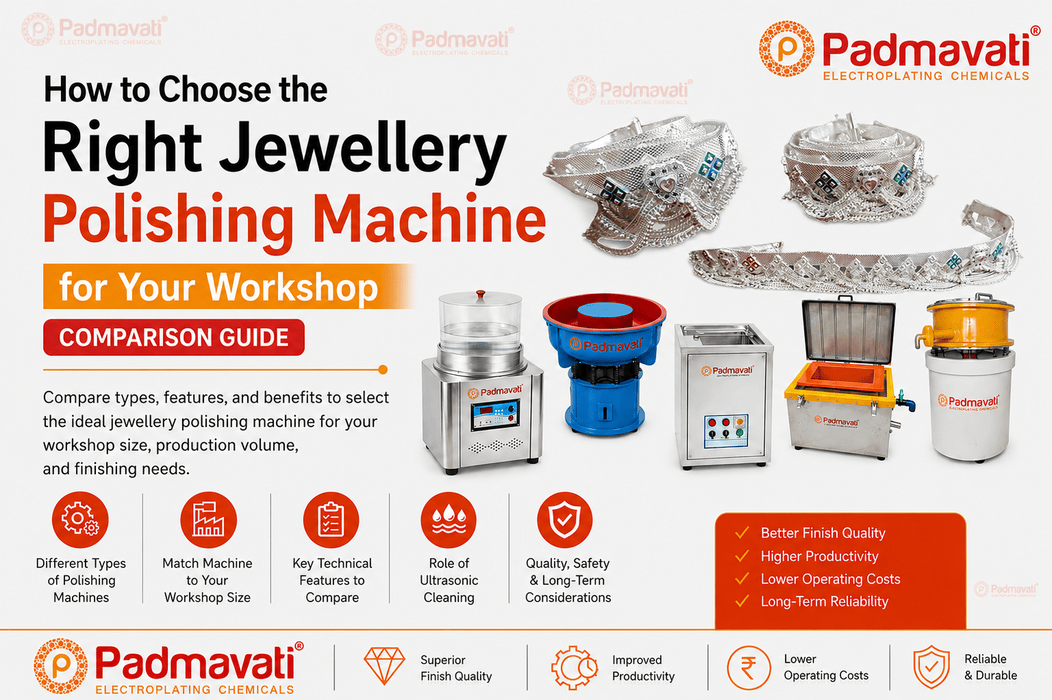
How to Choose the Right Jewellery Polishing Machine for Your Workshop | Comparison Guide
The right jewellery polishing machine can significantly improve product quality, reduce finishing time, minimize labour costs, and help maintain consistency across every jewellery piece. However, choosing the wrong machine often leads to production bottlenecks, uneven finishes, higher maintenance costs, and lower workshop efficiency. This guide will help you compare different jewellery polishing solutions and select the ideal machine based on your workshop size, production volume, and finishing requirements.
In jewellery manufacturing, polishing is not simply the final step—it directly influences the appearance, value, and customer perception of the finished product. Whether you operate a small artisan workshop or a large-scale manufacturing unit, selecting the right polishing equipment is essential for achieving professional results.
At Padmavati Chemtech Pvt Ltd., we work closely with jewellery manufacturers and understand that every workshop has unique requirements. This guide simplifies the decision-making process so you can invest confidently in the right solution.
Why Does Choosing the Right Jewellery Polishing Machine Matter?
A jewellery polishing machine does much more than create shine. It affects productivity, consistency, labour efficiency, and overall production quality.
When manufacturers choose equipment based solely on price, they often encounter issues such as:
- Inconsistent surface finishing
- Increased manual labour
- Higher production costs
- Longer turnaround times
- Frequent maintenance requirements
The right machine ensures repeatable results while helping your workshop meet growing production demands.
Skimmable Summary: Choosing the correct jewellery polishing machine improves finish quality, production speed, consistency, and long-term profitability while reducing operational challenges.
What Types of Jewellery Polishing Machines Are Available?
Understanding the available machine categories is the first step toward making an informed decision.
Manual Polishing Machines
These machines are suitable for small workshops and customized jewellery production. They offer greater operator control but require skilled labour.
Bench Polishing Machines
Commonly used in medium-sized workshops, bench polishers balance productivity and flexibility.
Centrifugal Disc Finishing Machines
These systems provide high-speed polishing for larger production volumes and complex jewellery designs.
Vibratory Finishing Machines
Ideal for batch processing, vibratory machines can polish multiple pieces simultaneously while maintaining consistency.
Magnetic Polishing Machines
Magnetic systems are excellent for intricate jewellery designs, reaching difficult internal areas that conventional polishing methods often miss.
Barrel Polishing Machines
These machines are suitable for mass production environments where uniform finishing is required across large batches.
Skimmable Summary: Jewellery polishing machines range from manual polishers to advanced magnetic, vibratory, and centrifugal systems. The ideal choice depends on production volume, design complexity, and desired finish quality.
How Do You Match a Polishing Machine to Your Workshop Size?
Many buyers focus on machine specifications without considering actual production requirements.
Small Workshops
If your workshop produces customized pieces in smaller quantities, manual or compact bench polishing systems may be sufficient.
Medium-Scale Manufacturers
Businesses handling moderate daily production often benefit from vibratory or magnetic polishing systems that improve efficiency while maintaining quality.
Large Manufacturing Units
High-volume production facilities typically require automated polishing solutions capable of processing large batches with minimal operator involvement.
Before purchasing, evaluate:
- Daily production volume
- Number of operators
- Jewellery types produced
- Available workspace
- Expansion plans
Buying for future growth often delivers better long-term value than purchasing solely for current needs.
Skimmable Summary: Workshop size and production volume should guide machine selection. Choosing equipment that supports future growth helps maximize long-term investment value.
Which Technical Features Should You Compare Before Buying?
Machine specifications directly impact performance and operating efficiency.
Motor Power
Higher motor power generally supports heavier workloads and continuous operation.
Capacity
Evaluate how many jewellery pieces the machine can process per cycle.
Speed Control
Variable speed settings provide greater flexibility for different jewellery materials and finishing requirements.
Noise Levels
Lower noise machines improve workplace comfort and operator productivity.
Maintenance Requirements
Machines with simpler maintenance procedures reduce downtime and operating costs.
Durability and Construction
Industrial-grade stainless steel construction typically offers superior longevity and corrosion resistance.
Automation Features
Advanced systems may include programmable cycles, timers, and automated controls that improve consistency.
Skimmable Summary: Compare motor power, capacity, speed control, durability, maintenance requirements, and automation features to identify the best jewellery polishing machine for your operation.
What Is the Role of Ultrasonic Cleaning in Jewellery Manufacturing?
Polishing alone cannot achieve optimal finishing results. Cleaning plays an equally important role.
An ultrasonic jewelry cleaner removes polishing compounds, dirt, oils, and microscopic contaminants from jewellery surfaces. This ensures a clean and flawless finish before final inspection or plating.
An ultrasonic cleaning machine uses high-frequency sound waves to create microscopic bubbles that clean hard-to-reach areas without damaging delicate jewellery.
Benefits include:
- Improved cleaning precision
- Reduced manual cleaning effort
- Better plating preparation
- Consistent finishing quality
- Faster production cycles
Many manufacturers integrate a jewelry cleaner machine directly into their finishing workflow to improve overall efficiency.
Modern workshops increasingly combine polishing equipment with an advanced ultrasonic-machine setup for superior finishing outcomes.
Skimmable Summary: Ultrasonic cleaning removes polishing residues and contaminants that traditional cleaning methods often miss, making it an essential part of modern jewellery finishing processes.
Should You Choose a Standalone Polishing Machine or a Complete Finishing Setup?
The answer depends on your production objectives.
Standalone polishing machines work well when polishing is your primary bottleneck.
However, many manufacturers achieve better results by integrating:
- Polishing systems
- Ultrasonic cleaning equipment
- Drying systems
- Surface treatment solutions
A complete finishing setup creates a streamlined workflow that improves consistency while reducing manual handling.
For growing workshops, an integrated approach often delivers better productivity and quality control.
Skimmable Summary: While standalone polishing machines are suitable for specific applications, complete finishing systems often provide greater efficiency, consistency, and production scalability.
How Do Operating Costs Affect Long-Term ROI?
Purchase price represents only a portion of total ownership costs.
When evaluating machines, consider:
Energy Consumption
Energy-efficient equipment reduces monthly operating expenses.
Maintenance Costs
Reliable machines typically require fewer repairs and replacement parts.
Labour Savings
Automation can significantly reduce labour requirements and increase throughput.
Production Efficiency
Faster cycle times contribute directly to higher profitability.
Machine Lifespan
Durable equipment provides greater return on investment over time.
A lower-priced machine may appear attractive initially but could become more expensive over its lifetime due to maintenance and productivity limitations.
Skimmable Summary: Long-term ROI depends on energy efficiency, maintenance requirements, labour savings, productivity improvements, and machine durability—not just initial purchase cost.
What Mistakes Should You Avoid When Buying a Jewellery Polishing Machine?
Many jewellery manufacturers make avoidable purchasing mistakes.
Common errors include:
Buying Based Only on Price
Low-cost equipment may compromise performance and reliability.
Ignoring Production Growth
Machines that cannot scale with your business may require premature replacement.
Overlooking Cleaning Requirements
Failing to integrate ultrasonic cleaning can limit finishing quality.
Ignoring After-Sales Support
Technical support and spare parts availability are critical for minimizing downtime.
Choosing Excessive Capacity
Oversized equipment may increase operational costs unnecessarily.
A balanced approach that considers both current and future requirements delivers the best results.
Skimmable Summary: Avoid selecting machines based solely on price, ignoring future growth, overlooking cleaning requirements, or neglecting after-sales support considerations.
Why Trust Padmavati Chemtech Pvt Ltd. for Jewellery Finishing Solutions?
At Padmavati Chemtech Pvt Ltd., we understand the challenges jewellery manufacturers face when selecting finishing equipment and process solutions.
Our focus extends beyond supplying products. We help manufacturers optimize polishing, cleaning, and finishing operations to achieve:
- Consistent product quality
- Improved production efficiency
- Reduced operating costs
- Better workflow integration
- Long-term business growth
By understanding your workshop’s unique requirements, we help you identify solutions that deliver measurable value rather than simply recommending equipment.
Skimmable Summary: Padmavati Chemtech Pvt Ltd. helps jewellery manufacturers improve finishing quality, operational efficiency, and long-term productivity through tailored polishing and cleaning solutions.
Conclusion
Choosing the right jewellery polishing machine is a strategic investment that directly impacts product quality, operational efficiency, and profitability. The best solution depends on your production volume, workshop size, finishing requirements, and future growth plans.
By carefully comparing machine types, technical specifications, operating costs, and cleaning integration options such as ultrasonic systems, you can build a finishing process that consistently delivers superior results.
At Padmavati Chemtech Pvt Ltd., we believe that informed decisions lead to stronger manufacturing outcomes. Investing in the right polishing and cleaning technology today can create lasting advantages for your workshop tomorrow.
FAQs
How do I choose the right jewellery polishing machine for my workshop?
Yes, the right machine should match your production volume, jewellery type, and finishing requirements.
For example, a small workshop producing custom jewellery may benefit from a bench polishing machine, while a large manufacturer processing thousands of pieces weekly may require automated vibratory or magnetic polishing systems. Always evaluate current production and future growth before purchasing.
Is an ultrasonic jewelry cleaner necessary after polishing?
Yes, ultrasonic cleaning is highly recommended after polishing.
Even when jewellery appears clean, polishing compounds and microscopic residues often remain in small crevices. An ultrasonic jewelry cleaner removes these contaminants efficiently, helping achieve a cleaner and more professional finish.
What is the difference between a polishing machine and an ultrasonic cleaning machine?
A polishing machine improves surface finish and shine, while an ultrasonic cleaning machine removes contaminants.
Think of polishing as creating the shine and ultrasonic cleaning as revealing that shine by removing leftover compounds, oils, and debris from the jewellery surface.
Which polishing machine is best for intricate jewellery designs?
Magnetic polishing machines are often the best choice for highly detailed jewellery.
Their ability to reach internal grooves, tiny cavities, and complex geometries makes them ideal for modern jewellery designs that traditional polishing methods may struggle to finish uniformly.
How often should jewellery polishing machines be maintained?
Most machines should be inspected and maintained according to manufacturer recommendations.
In high-production environments, regular cleaning, lubrication, and component inspections help prevent downtime and ensure consistent finishing quality. Preventive maintenance is always more cost-effective than emergency repairs.
Can a jewelry cleaner machine improve production efficiency?
Yes, significantly.
Instead of manually cleaning each piece, a jewelry cleaner machine can process multiple items simultaneously. For example, a workshop producing hundreds of rings daily can save substantial labour hours while achieving more consistent cleaning results.
What factors affect the ROI of a jewellery polishing machine?
The biggest factors include productivity, maintenance costs, energy consumption, labour savings, and machine lifespan.
A machine that reduces polishing time by even a few minutes per batch can create substantial annual savings, especially in medium and large-scale jewellery manufacturing operations.
Conclusions
The rise in global silver prices is not just a market challenge—it is also a major opportunity for the electroplating industry.
As manufacturers seek cost-effective alternatives to solid silver, demand for silver electroplated jewellery, decorative items, and industrial components is expected to grow rapidly.
For companies involved in silver electroplating chemicals and additives, this evolving market presents a powerful opportunity to expand production, innovate plating technologies, and support manufacturers worldwide.
Businesses that focus on efficient plating chemistry, consistent quality, and optimized metal utilization will play a key role in the future of the silver electroplating industry.