
Electroplating Rectifier – Manufacturer & Supplier in India
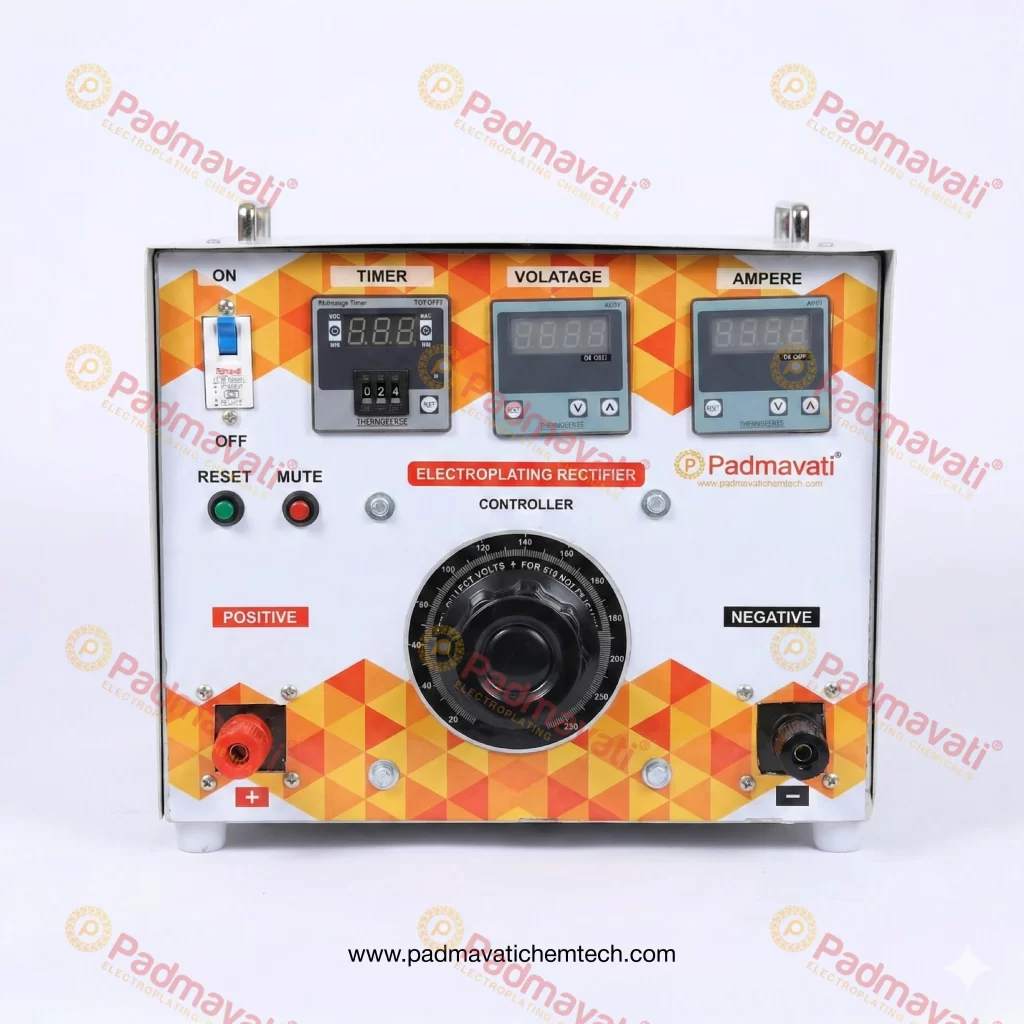
Electroplating Rectifier
TYPES: Air-Cooled Rectifiers, Oil-Cooled Rectifiers, IGBT Rectifiers, Thyristor-Based Rectifiers
APPLICATIONS: Gold Plating, Silver Plating, Nickel Plating, Chrome Plating
HOW TO CHOOSE: Ampere & Voltage Requirements, Duty Cycle, Ripple Factor
Key Benefits
High efficiency with lower power consumption
Minimal heat generation for longer component life
Stable DC output for better adhesion and surface finish
Protection systems against overload and short circuits
Auto cut-off with timer and buzzer for process control
| No. | Capacity |
|---|---|
| 1 | 10 A / 8 V |
| 2 | 50 A / 12 V |
| 3 | 100 A / 12 V |
| 4 | 150 A / 12 V |
| 5 | 250 A / 18 V |
| 6 | 25 A / 80 V – For Lacquer Application |
Available Features
Digital ampere and volt meters
SMPS / IGBT / MOSFET based design
Low ripple output
Compact and lightweight build
Optional ampere-hour meter
Custom specifications on request
What Is an Electroplating Rectifier?
An electroplating rectifier converts AC power to controlled DC output required for the electroplating process. Padmavati Chemtech is a trusted electroplating rectifier manufacturer in India, supplying rectifiers for electroplating in ratings from 50 Amp to 3000 Amp for gold, silver, nickel, and chrome plating applications. Our electroplating rectifiers feature digital displays, overload protection, and energy-efficient designs suitable for jewellery workshops and industrial plating plants.
Types of Electroplating Rectifiers We Manufacture
Types of Electroplating Rectifiers include air-cooled rectifiers for standard applications, oil-cooled rectifiers for high-load continuous operations, and high-frequency (SMPS) rectifiers for energy-efficient and precise output control. Variants are available with features like digital control panels, automatic voltage/current regulation, and customization based on plating processes such as gold, silver, nickel, chrome, and zinc.
Electroplating Rectifier Specifications & Models
Electroplating Rectifiers are available in multiple models based on output current (amps), voltage range, and cooling type. Common specifications include 0–12V/0–500A for light applications and up to 0–24V/5000A or higher for heavy-duty use. Options include air-cooled or oil-cooled systems, digital or analog control panels, and features like precise current regulation, overload protection, and continuous duty operation for consistent plating quality.
How to Choose the Right Rectifier for Electroplating
Choosing the right rectifier for electroplating depends on your process requirements and production scale. Key factors include required voltage and current output based on the metal being plated, tank size, and load density. Consider cooling type (air or oil), duty cycle, and control accuracy for consistent results. For advanced applications, SMPS rectifiers offer better efficiency and precise regulation, while heavy-duty setups may require robust oil-cooled systems.
Applications of Electroplating Rectifiers
Electroplating Rectifiers are used to supply controlled DC power for various metal finishing processes. They are widely applied in industries such as automotive, electronics, hardware, aerospace, and jewellery for plating metals like gold, silver, nickel, chrome, and zinc. These rectifiers ensure uniform coating thickness, improved corrosion resistance, enhanced surface finish, and reliable performance in both small-scale and high-volume production environments.
Electroplating Rectifier Price Range
The price of electroplating rectifiers in India varies widely based on current capacity (amps), voltage range, cooling system, and technology (SCR or SMPS). Small units (low amp, lab-scale) can start from around ₹40,000–₹50,000, while standard industrial models typically range between ₹1,00,000 to ₹2,00,000. High-capacity or advanced rectifiers with digital control and heavy-duty output can go from ₹3,00,000 up to ₹10,00,000+ depending on specifications.
Why Choose Padmavati Chemtech as Your Rectifier Manufacturer?
Padmavati Chemtech is trusted for manufacturing high-quality electroplating rectifiers with a focus on performance, durability, and precision control. Each unit is built using robust components, ensuring stable output and long service life. With flexible customization, energy-efficient designs, and dependable technical support, the solutions are tailored to meet diverse industrial plating requirements while optimizing productivity and operational cost.
Frequently Asked Questions
An electroplating rectifier converts AC (alternating current) into controlled DC (direct current) required for the electroplating process. It supplies stable voltage and current to deposit a uniform metal layer onto a component. Precise control of output ensures consistent coating thickness, better adhesion, and improved surface quality across different plating applications.
The price of an electroplating rectifier in India varies based on current capacity, voltage range, cooling system, and technology (SCR or SMPS). Small or lab-scale units can start from around ₹10,000–₹50,000, while standard industrial models typically range between ₹80,000 to ₹2,00,000. High-capacity or fully automated rectifiers can cost anywhere from ₹3,00,000 to ₹10,00,000 or more depending on specifications and load requirements.
For gold electroplating, the best rectifier is typically a high-frequency SMPS (IGBT-based) rectifier, as it provides highly stable DC output with very low ripple, which is critical for achieving a smooth, uniform, and high-quality gold finish.
The required amps for an electroplating setup depend on the surface area of the parts and the current density of the plating process. A common rule is 1–5 amps per square decimeter (ASD), depending on the metal being plated (e.g., gold requires lower current density than zinc).
Air-cooled rectifiers use fans and heat sinks to dissipate heat, making them suitable for low to medium current applications with intermittent usage. They are compact, cost-effective, and easier to maintain.
Oil-cooled rectifiers, on the other hand, use transformer oil for cooling, allowing efficient heat dissipation in high-current, continuous-duty operations. They are more robust, handle heavy loads better, and offer longer life in demanding industrial environments.
A regular DC power supply can be used for basic or small-scale electroplating, but it is not ideal for consistent industrial results. Electroplating rectifiers are specifically designed to provide stable, low-ripple DC output with precise current control, which is critical for uniform coating and proper adhesion. Standard power supplies may lead to uneven plating, poor finish, and lack the durability required for continuous operation.